
Sometimes the smallest gestures leave the deepest marks — not because they’re grand or expensive, but because they arrive exactly when someone needs a little light. I didn’t realize, two years ago, that one ordinary afternoon in a crowded grocery store would one day come full circle in the most unexpected and humbling way.
It was a hectic day like any other. The grocery store was buzzing with the usual sounds of carts squeaking, checkout beeps, and distant chatter. I was rushing between errands, slightly overwhelmed by my to-do list, when I noticed a couple a few places ahead of me in line, standing at the register with their small child in the cart. Their items were already bagged when something changed — the cashier quietly informed them that their card had been declined.
You could almost feel the shift in their energy. The woman’s face flushed with embarrassment, the man checked his pockets for another form of payment, and the child—maybe 5 or 6—looked around nervously, clutching a small box of cereal. The tension in the air was thick. A moment that should have been ordinary was now heavy with discomfort.
Without overthinking it, I stepped forward and offered to cover their bill. It wasn’t a huge amount. I don’t even remember the exact figure, and honestly, I didn’t expect anything in return. I only remember the look in their eyes—shocked, grateful, emotional. The woman tried to object, but I gently insisted. “It’s okay. I’ve had help before, too.”
The moment passed quickly. We exchanged a few words, I paid, and they left the store. I didn’t ask their names, and within a few weeks, I forgot the encounter entirely. It was just a fleeting moment of kindness in a busy life.
But life has a way of circling back when you least expect it.
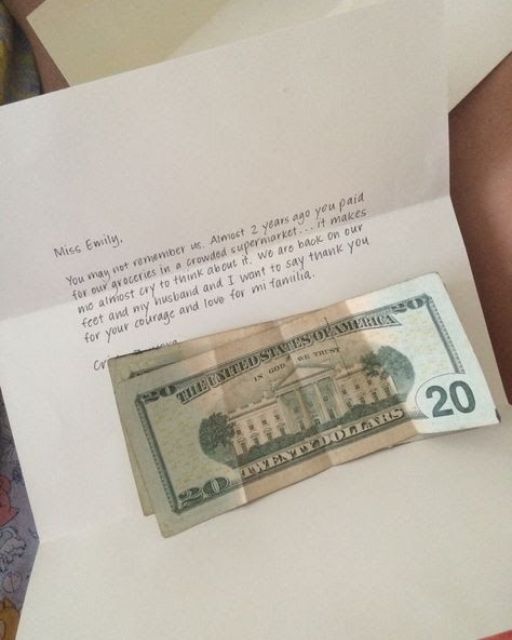
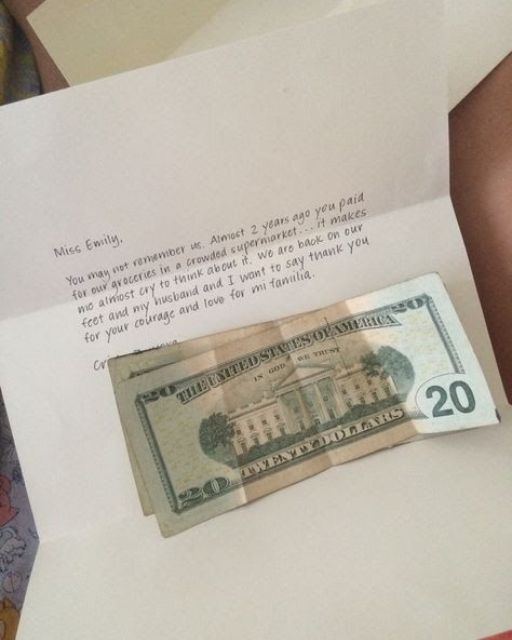
Two years later, I came home from work to find a plain, unmarked envelope slipped into my mailbox. Inside was a twenty-dollar bill and a handwritten note. The handwriting was uneven, slightly shaky, but careful and deeply sincere. The note began:
“Dear stranger, two years ago at the supermarket, your kindness changed our lives. You didn’t know us, and you didn’t ask for anything in return. That day, our card had been declined because we were drowning in medical debt. Our daughter, Sofia, was in the hospital, fighting a rare blood disorder. Every cent we had went to her treatment. That grocery trip was our attempt at ‘normal.’ You helped us hold on to dignity when we had so little left to hold.”
As I read, I felt a lump form in my throat. I turned the note over and found something that brought tears to my eyes — a drawing made in crayon by a child, with uneven letters beneath it:
“My mamá said you are why I want to help people now.”
The drawing showed a stick figure with big smiling eyes handing a bag of groceries to another figure holding a little girl’s hand. It was simple, sweet, and devastatingly beautiful.
Also tucked inside the envelope was a photograph. In it, a young girl lay in a hospital bed, her head bald but her smile wide and full of light. There was a warmth in her eyes that no illness could dim. Her name was written on the back: Sofia.
Still processing what I had read, I returned to the grocery store the next day and spoke with a kind-hearted cashier who recognized the story. She told me that Sofia had been battling a rare blood disorder — one that required frequent treatments and long hospital stays. The family had struggled silently, trying to stay afloat both financially and emotionally. That day, my simple gesture — paying for their groceries — had apparently meant more than I ever could’ve imagined. It wasn’t just about the food. It was about being seen.
I went home that night, deeply moved and unsure how to respond. After some thought, I decided not to keep the money they had returned. Instead, I slipped the twenty-dollar bill into a children’s book about empathy and compassion. Inside, I wrote a message:
“For someone who needs a little light today. Keep the kindness going.”
I left it anonymously at a local library’s reading nook, hoping that some child, some parent, someone, would find it at just the right time. I didn’t tell anyone about it. It wasn’t meant for recognition — it was about continuing the ripple that had started years ago.
Weeks passed, and I often thought of that letter. Then, one quiet Sunday morning, I received an email from someone named Clara. The subject line simply read: “Thank you — from Sofia’s mom.”
Her message told me that Sofia had recently gone into remission. She was growing stronger every day, and her outlook had improved significantly. Clara shared that the memory of that day — a stranger paying for their groceries — had stayed with her like a light in the darkest moments. Inspired by the act, and by Sofia’s recovery, she had started an online community to support other parents of children with rare diseases.
Her message ended with an invitation to meet.
We sat down together at a small café that weekend. I saw Clara’s eyes light up when she spoke of Sofia — now active, painting, dreaming of becoming a nurse someday. She showed me more pictures, including one of Sofia holding up a hand-painted sign that read: “Kindness wins.”
That day, sitting across from a mother who had once been a stranger, I realized how far one simple act had traveled. A moment I had nearly forgotten had grown roots, sprouted hope, and even helped build a supportive online network for hundreds of struggling families.
I walked away from that café changed.
Since then, I’ve become more involved in local volunteer efforts. I’ve joined food drives, participated in fundraising for children’s hospitals, and even started speaking at community events about the power of everyday kindness. I learned firsthand that you don’t have to move mountains to change someone’s world. Sometimes, all it takes is paying for groceries.
That moment in the supermarket wasn’t about money. It was about connection, about hope, about the silent agreement we all have — to look out for one another, even when life is messy and uncertain.
Because kindness isn’t just an act. It’s a seed. And if we plant enough of them, the world blooms into something more beautiful than we ever imagined.