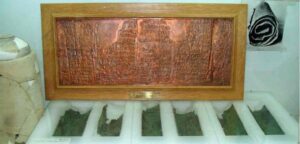

There are literally thousands of incredible texts that have survived from the ancient world, which are etched onto copper, beautifully inscribed on papyrus, chipped onto tablets, and even written using the ink of ground down gold and precious stones. While it is impossible to choose the best of the bunch, we have chosen ten incredible texts to feature, which have served to open new windows onto the daily lives of our ancestors and enhanced the knowledge we hold about our ancient past.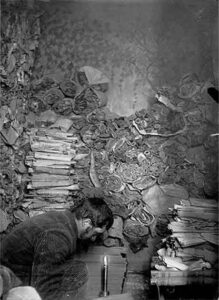
The Dunhuang Manuscripts are a cache of around 20,000 important scrolls found in the Mogao Caves of Dunhuang in China. The Dunhuang Manuscripts are a collection of incredible texts that date to between the 5th and 11th centuries AD. The majority of these ancient texts were discovered by a Daoist monk in 1900, having been sealed up in a chamber within a cave and hidden for about 900 years. Many of them were then sold to European explorers, while the remaining texts were taken to Beijing and can now be visited at the National Library of China.
Although the Dunhuang Manuscripts contain mostly Buddhist texts, there were other forms of sacred texts as well. These include Taoist, Nestorian Christian and Manichaean texts. In addition, there were also secular texts that dealt with various areas of knowledge, such as mathematics, history, astronomy and literature.
The manuscripts include a remarkable array of folk literature. This rich tapestry of narratives offers a unique perspective into the lives and experiences of ordinary people, unveiling their intricate connections with society, governance and kinship. These incredible texts not only illuminate personal experiences but also offer invaluable insights into the collective ethos of bygone eras.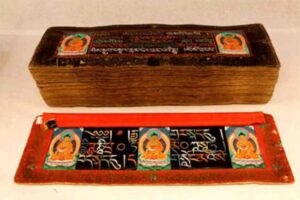
Incredible Ancient Texts #2. The Kangyur Written with Nine Precious Stones
Tibetans practiced a form of Shamanism called Bon. From the 6th to 8th centuries AD, Buddhism slowly penetrated this mountainous region. The teachings of the Buddha were translated into Tibetan, but its final compilation was only achieved in the 14th century. This resulted in the creation of the Tibetan Buddhist Canon, which consisted of the Kangyur, the “translated words (of the Buddha).”
As copies were made of the original Kangyur, this text was disseminated throughout Tibet. One of these copies is the Kangyur written with nine precious stones, which is the only copy in the world. The ink used in the writing of this Kangyur is literally made from “precious stones,” namely gold, silver, coral, pearl, mother of pearl, turquoise, lapis lazuli, copper and steel, making it one of the most incredible ancient texts in the world.
These were first made into powder and placed into cups designated for each “stone.” Some fresh water from a mountain spring or rainwater was then mixed with special sweet adhesives (goat’s milk) and added to the cups to produce the ink. Then, using a painting brush made of sable fur, the ink was be used to write on processed black paper.
In addition to the text, paintings were also added to the Kangyur. These images were painted according to the artistic tradition of Zanabazar. Legend has it that the Kangyur “immediately give peace of mind and admiration to anybody who looks at it.”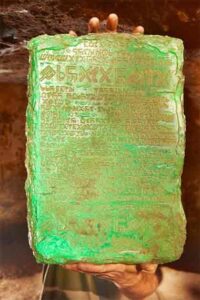
Incredible Ancient Texts #3. The Legendary Emerald Tablet
The Emerald Tablet is said to be a tablet of emerald or green stone inscribed with the secrets of the universe. The origin of the original Emerald Tablet remains shrouded in mystery, enveloped by a veil of ancient legend and lore.
The most common legend claims that the tablet was found in a caved tomb under the statue of Hermes in Tyana, clutched in the hands of the corpse of Hermes Trismegistus himself. Another legend suggests that it was the third son of Adam and Eve, Seth, who originally wrote it. Others believed that the tablet was once held within the Ark of the Covenant. Some even claim that the original source of the Emerald Tablet is none other than the fabled city of Atlantis.
The Emerald Tablet would become one of the pillars of Western alchemy. It was a highly influential text in Medieval and Renaissance alchemy, and probably still is today. In addition to translations of the Emerald Tablet, numerous commentaries have also been written regarding its contents. Yet, despite the various interpretations available, it seems that none of their authors claim to possess knowledge of the whole truth.
Incredible Ancient Texts #4. The Egyptian Dream Book
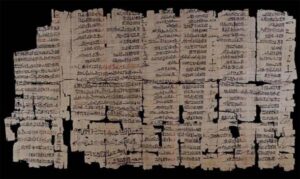
The Egyptian Dream Book is preserved in the form of a papyrus with a hieratic script. This papyrus was found in the ancient Egyptian workers’ village of Deir el-Medina, near the Valley of the Kings. Dated to the early reign of Ramesses II (1279-1213 B.C.), each page of this incredible text begins with a vertical column of hieratic signs which translates as “If a man sees himself in a dream.”
In each horizontal line that follows, a dream is described, accompanied by the diagnosis “good” or “bad,” alongside its interpretation. For instance: “If a man sees himself in a dream looking out of a window, good; it means the hearing of his cry.” The good dreams are listed first, followed by the bad ones written in red, symbolizing bad omens.Top of Form