


The $2 bill has long been a subject of fascination, often seen as unlucky or even cursed by some. Despite its reputation, this unique piece of currency is far from jinxed. In fact, the $2 bill might be worth much more than its face value, especially for collectors and those with rare editions. Let’s dive into the history, the myths, and the true value of the $2 bill, which remains a curious and often misunderstood part of American currency.
The Myth of the Unlucky $2 Bill
For many, the $2 bill carries a bit of superstition. It’s often thought to bring bad luck, with some even believing that it could be cursed. This belief might stem from its rare usage or its unpopularity compared to other denominations like the $1 or $20 bills. The $2 bill is often seen as an oddity, and because it’s not commonly used in everyday transactions, some people have even gone as far as damaging the bill in hopes of reversing the curse. However, despite these myths, there’s no factual evidence to support that the $2 bill is unlucky. On the contrary, for collectors, it can be a prized possession, and in certain cases, it can fetch a substantial amount of money, far exceeding its face value.
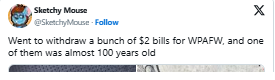
A Rare and Unique Bill
Although it’s not widely circulated, the $2 bill is far from extinct. In fact, as of 2023, there were 1.6 billion $2 bills in circulation in the United States. While this is a relatively small number compared to the billions of $1 and $20 bills in circulation, the $2 bill still holds a unique place in the country’s currency system. This rarity only adds to its appeal for collectors, making it a fascinating piece of American history.
The $2 bill has had an interesting evolution since its inception. Originally introduced in 1862, the first $2 bill featured Alexander Hamilton. However, it wasn’t until 1869 that the bill was redesigned to feature Thomas Jefferson, a design that remains on the bill to this day. Despite its long history, the $2 bill has always been somewhat unpopular, likely due to its less frequent use in everyday transactions.

The Value of the $2 Bill: Beyond Face Value
While the $2 bill may not see as much use as other denominations, it can still be quite valuable, especially for collectors or those who come across rare versions. In fact, some $2 bills are worth far more than the amount printed on them. Here’s a look at how much these bills could be worth depending on their age, condition, and special features:
1. Older $2 Bills (1862–1896)
Older, uncirculated $2 bills from 1862–1896 with red, brown, or blue seals are highly sought after and can fetch prices of up to $5,000. Even circulated versions from this era can still be worth around $1,100. The rarity of these older bills, combined with their historical significance, makes them highly valuable in the world of currency collecting.
2. $2 Bills from 1917–1928

Bills from the period between 1917 and 1928 with red or blue seals also have considerable value. Depending on their condition, these bills can be worth anywhere from $50 to $1,000. The condition of the bill plays a significant role in its value, with well-preserved bills commanding higher prices.
3. Fancy Serial Numbers
One of the most interesting aspects of collecting $2 bills is the potential for a fancy serial number to significantly increase the bill’s value. A fancy serial number refers to a bill with a unique or aesthetically appealing sequence of numbers, such as repeating numbers, low serial numbers, or patterns that collectors find interesting. These bills can be worth up to $6,000, depending on their rarity and condition.
The Appeal of the $2 Bill
Despite its occasional unpopularity, the $2 bill remains an intriguing piece of currency. Its rarity and historical value make it a collectible item for those who appreciate the nuances of currency collection. While the myth of the “unlucky” $2 bill persists in popular culture, there’s no denying that it holds a unique charm and can be worth a significant amount of money for those who have the right version.
Collectors often seek out specific years or serial numbers, while others are drawn to the simple fact that the $2 bill is rarely seen in everyday transactions. The design, which still features Thomas Jefferson on the obverse, along with the distinctive colors and patterns, adds to its appeal.
How to Determine If You Have a Rare $2 Bill
If you’ve come across a $2 bill and are wondering whether it’s a valuable collectible, there are a few things to look for:
Age: Older $2 bills, especially those from the late 19th or early 20th century, tend to have higher value.
Condition: Bills in uncirculated condition are always worth more than those that are worn or damaged.
Seal Color: Pay attention to the seal color on the bill, as older bills with red, brown, or blue seals are more valuable.
Serial Number: Look for fancy serial numbers (such as repeating numbers or low numbers), as these can greatly increase the bill’s worth.
Special Edition Notes: Sometimes, the U.S. Treasury will issue limited edition bills, which can carry added value.
Conclusion: The $2 Bill – Not Unlucky, Just Rare
While the $2 bill may have a reputation for being unlucky, it’s actually a rare and valuable item for currency collectors. Whether it’s an older bill with a colored seal, one with a fancy serial number, or simply a well-preserved note from the 20th century, a $2 bill can be worth far more than its face value.
So, if you have a $2 bill tucked away in your wallet or safe, it might be worth taking a closer look. You never know – you could be holding onto a valuable piece of history! Let us know if you have any rare $2 bills, and share your discoveries with us.