

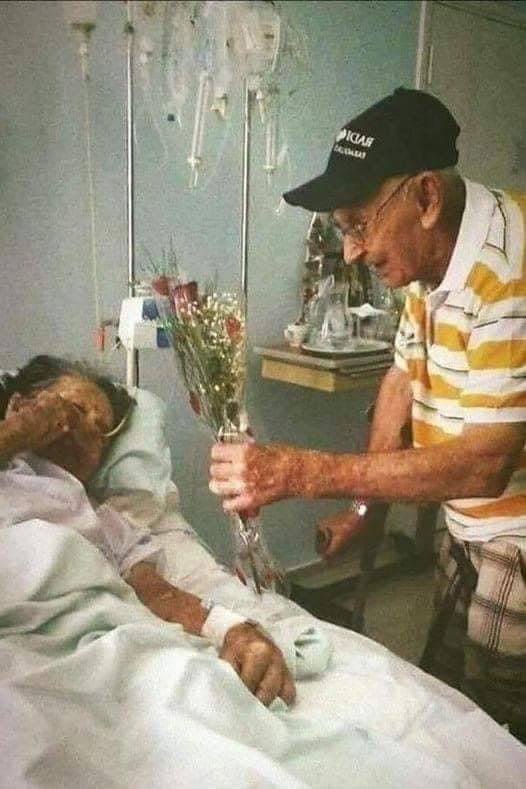
Growing old with the one you love is a dream that many carry with them through every season of life. From the early moments of a budding relationship, when laughter comes easily and the future stretches out in glowing possibility, to the shared triumphs and trials of family, work, and the passage of time, the hope of aging together forms a cornerstone of countless love stories. But what happens when the aging process doesn’t unfold as a tranquil winding-down of a life well-lived together? What happens when age brings not only wrinkles and slower steps, but the slow erosion of memory — when a beloved face forgets your name, your voice, even your presence?
This is the reality for many couples, and yet within the heartbreak lies something profoundly beautiful: the unwavering devotion of one heart holding fast, even when the other forgets.
In a small, peaceful town that feels far removed from the noise and hurry of the modern world, there stands a modest nursing home. It’s not the kind of place that draws attention. Its walls are painted in soft pastels, the rooms filled with familiar furniture and sunlight that trickles through curtains. It is quiet, but not somber. It is a place of care, and more often than not, of quiet courage. Within these walls lives a story — not one shouted from the rooftops or broadcast on the news, but one that unfolds gently, day after day, through simple acts of love.

Every morning, before most of the residents have stirred, an 80-year-old man rises from his bed, dresses with care, and prepares for a ritual he has never abandoned. His routine is familiar — he buttons his shirt, combs his thinning silver hair, and takes slow, deliberate steps to the small kitchen area. There, he arranges a breakfast tray with the same care he would have used decades earlier when planning a romantic surprise for a younger version of the woman he still loves.
The breakfast isn’t elaborate — toast, a bit of scrambled eggs, a cup of tea with just the right amount of milk. Some days, there’s a piece of fruit. On rare occasions, if the home’s garden is in bloom, he might tuck a small flower into the corner of the tray. But the beauty isn’t in the food. It’s in the intention. It’s in the quiet love that accompanies each small detail.
He carries the tray through the corridor, greeting the nurses with a gentle smile. They know him well by now. His presence is part of the morning rhythm. For new staff members, he’s often introduced with reverence: “That’s Mr. Whitmore. He brings his wife breakfast every day.” They whisper it as though sharing a sacred secret.

And then, he reaches her room.
Inside, a woman lies resting. Her hair, once thick and dark, is now a soft white halo. Her eyes, once filled with warmth and recognition, now flicker with confusion more often than not. Alzheimer’s has woven its cruel tapestry through her mind, blurring the lines of past and present, turning familiar faces into strangers and shared memories into shadows.
She does not know that the man who enters her room each morning is the same man who once held her hand in a crowded dance hall in the spring of 1964. She does not remember the way they painted the nursery together, their hands speckled with yellow paint. She cannot recall the family road trips, the holidays spent laughing over mismatched decorations, or the quiet evenings spent reading side by side in their living room.
To her, he is simply a kind man who brings her food.
But to him — she is everything.
When asked why he continues the ritual, even though she does not recognize him, his answer is both simple and devastatingly profound: “She doesn’t know who I am, but I know who she is.”
There is something extraordinary in those words. They echo with decades of shared life. They resonate with the deep hum of enduring love — love that is not dependent on being seen, or acknowledged, or remembered. Love that simply exists because it always has, and always will.
Their love story, like so many, began with a spark. They met in their early twenties. He was quiet and thoughtful; she was radiant and full of laughter. Their connection was instant, though neither of them knew at the time just how much of life they would navigate together. There were highs — promotions, family holidays, the birth of their children. And there were lows — job losses, health scares, nights of grief when loved ones passed away. But through it all, they remained each other’s constant.
As the years passed and they grew older, they looked forward to retirement as a time to rest, to travel, to enjoy the fruits of decades of labor. And for a time, they did. But then the small things began. Repeating questions. Misplaced items. Forgotten appointments. At first, they laughed them off — age, after all, brings forgetfulness. But soon, the signs could no longer be ignored. Tests were done. Words like “dementia” and “Alzheimer’s” were introduced into their vocabulary. And their world changed forever.
For many, such a diagnosis feels like an ending. And in many ways, it is. But for this man, it became a new beginning — not of romantic adventures or shared goals, but of a quieter, deeper love. A love that shows up even when it isn’t seen. A love that continues not because of what is received, but because of who they once were — and who they still are, even as time tries to erase it.
He watched as her memory faded — as she forgot names, dates, and eventually, even faces. He held her hand through the nights she didn’t know where she was. He calmed her when she panicked, assured her when she was afraid. And when the day came that she no longer knew who he was, he didn’t walk away. Instead, he committed himself even more fully to being present for her, in whatever way she needed.
Bringing her breakfast became more than a habit. It became a promise. A vow renewed every single day. A reminder that, though she may forget, he will always remember.
The staff at the home began to notice the impact of his daily visits — not just on his wife, but on the entire atmosphere. Other residents, some of whom had few visitors, looked forward to seeing him. His consistency inspired families struggling with their own loved ones’ illnesses. Caregivers who faced daily stress found themselves pausing to witness this gentle ritual, reminded of the sacredness of their work.
One nurse began recording his visits in a journal, noting small details: the way he smoothed his wife’s hair, the way he read to her from an old poetry book, the way he never seemed to grow tired of the same routine. “It’s the truest form of love I’ve ever seen,” she wrote. “Not loud. Not dramatic. Just real, and present, and persistent.”
Over time, this love story began to ripple beyond the walls of the nursing home. Family members shared it with friends, who shared it with others. It made its way into conversations about caregiving, aging, and the enduring nature of relationships. And always, it returned to that one line: “She doesn’t know who I am, but I know who she is.”
That sentence became a kind of mantra — a powerful reminder that love is not always about what we receive. It’s about what we give, even when it hurts. Especially when it hurts.
And so, morning after morning, he continues. Some days are harder than others. His own body aches. His hands tremble. But he never misses a day. Each breakfast is prepared with the same care. Each visit is made with the same tenderness. And though she may never again speak his name, he continues to speak hers, whispering it softly as he smooths her blanket or kisses her forehead goodnight.
This story is not just about an elderly man and his wife. It’s about all of us. It’s about the kind of love we aspire to. The kind that endures. The kind that isn’t dependent on being seen or remembered, but is rooted in something deeper — a commitment made long ago, honored every single day.
In a world that often feels chaotic and uncertain, this story offers a quiet anchor. It reminds us that love, in its truest form, is not loud or flashy. It’s found in the simple things — in bringing someone breakfast, in showing up, in choosing to stay.
And perhaps most importantly, it reminds us that even when memory fades, love does not. Love, real love, lives on — in gestures, in rituals, in the quiet, faithful presence of one person who chooses to remember, even when the other cannot.
Growing old with the person you love is often imagined as a beautiful, peaceful chapter in the book of life — a season where shared memories blossom into gentle routines, quiet companionship, and enduring connection. But for many couples, the reality of aging can introduce heart-wrenching challenges that test even the strongest of bonds. One of the most profound of these challenges is when age-related illnesses, like Alzheimer’s disease, begin to slowly unravel the tapestry of shared memories, leaving behind confusion, forgetfulness, and emotional distance.
Alzheimer’s is a cruel and complicated disease. It doesn’t strike like a lightning bolt; instead, it arrives slowly, gradually stealing moments, names, and eventually the very essence of a person’s identity. For the loved ones watching this unfold, it can be devastating — a daily exercise in grief for the person who is still physically present but mentally slipping away. Yet within this painful experience, some stories shine like beacons of hope and humanity. These are the stories that remind us that love, when built on a foundation of deep commitment and genuine care, can transcend even the most formidable obstacles.
One such story unfolds in the serene hallways of a modest nursing home tucked away in a quiet corner of the country. The setting is unassuming — a place where gentle morning light filters through lace-curtained windows, and the days pass in gentle rhythms of care, meals, and medication. Among the residents is an 80-year-old man whose actions speak louder than words ever could. Every single morning, without fail, he walks the familiar corridor to deliver breakfast to a woman who no longer recognizes him — his wife of over five decades, now living with advanced Alzheimer’s disease.
Each morning begins the same way. He rises early, as he has done for years, carefully dresses in a button-down shirt and slacks, and makes his way to the kitchen area of the home. There, he requests her favorite breakfast — toast lightly buttered, scrambled eggs just the way she likes them, and a small cup of tea with a splash of milk. With gentle hands, he arranges everything on a tray, sometimes tucking in a small flower from the garden outside if the season allows. He carries this tray through the hallways, nodding politely at nurses and aides who have grown used to this quiet act of devotion. He does not ask for help. He does not seek praise. He simply delivers love, one breakfast at a time.
When he enters her room, he greets her softly, as if they were newlyweds waking up to their first morning together. Sometimes she smiles; sometimes she stares blankly. On certain days, she seems startled by his presence. Most days, though, she looks at him with no recognition. The sparkle of familiarity that once lit up her eyes when she saw him has long since faded. She does not call his name. She does not know his face. She has no idea that this man was once the center of her world.
And yet — he stays. He does not let her forgetfulness diminish his resolve. He sits beside her, helps her eat if needed, chats softly about the weather or the flowers blooming outside, sometimes recalling memories aloud even if she cannot share them. He speaks of the day they met, their favorite vacation to the coast, the songs they danced to in their youth. He paints these memories into the air like a mural she no longer sees, but he keeps them alive nonetheless.
One day, a curious staff member, deeply moved by this quiet routine, approached him gently and asked, “Why do you do this every morning if she doesn’t remember who you are?”
The old man paused, looked down at his weathered hands, and then smiled. His eyes, though tinged with the sorrow of loss, glowed with something far deeper — unwavering love. He replied with words that would echo in the hearts of everyone who heard them:
“She doesn’t know who I am, but I know who she is.”
In that simple sentence lay a universe of meaning — a profound testimony to the power of love, loyalty, and the enduring nature of human connection. His devotion was not dependent on being recognized. It was not fueled by reciprocation or acknowledgment. His love was an offering, a sacred act of remembrance and presence.
The nursing home staff began to see his actions in a new light. What had once seemed like a touching routine became a daily lesson in resilience and compassion. They started sharing his story with new caregivers, residents, and even family members of other patients, using his example as a way to illustrate that love does not need to be seen or returned to be real. It only needs to be given, freely and consistently.
This man’s quiet, faithful act stands in stark contrast to a world that often focuses on the fleeting — quick answers, short-term gratification, and disposable relationships. His story reminds us of the power of commitment that spans a lifetime, of vows that endure through every challenge — not just the joyful days, but the painful ones too. “In sickness and in health,” those words are often spoken in wedding ceremonies, but few truly understand their weight until sickness arrives in a form as devastating as memory loss.
To love someone who can no longer recognize you is perhaps one of the greatest tests of human devotion. It demands patience, empathy, and a deep inner strength. It requires letting go of ego, of the need to be seen or appreciated. It is love at its purest — selfless, unwavering, and deeply rooted in memory, even if those memories live only on one side of the relationship.
As time passes, the man continues his ritual. Every morning, the same steps, the same tray, the same gentle voice offering love and care. He doesn’t know how many mornings remain. But he cherishes each one, treating every visit not as a burden, but as a blessing — another opportunity to honor the woman who once walked beside him through decades of shared laughter, challenges, and dreams.
This story, though centered on a single man and woman, speaks to something far greater. It serves as a poignant reminder to all of us that love — true, enduring love — does not fade when memories do. It does not rely on recognition or verbal affirmation. It lives in action, in choice, in the quiet consistency of showing up every day, no matter what.
In a world where so many things are fleeting, and where relationships can sometimes be treated as disposable, stories like this call us back to what matters most. They remind us of the sacred nature of commitment, the quiet power of everyday kindness, and the extraordinary beauty of love that persists through the hardest seasons of life.
As we navigate our own lives — with their joys, their griefs, and their ever-changing landscapes — may we carry this story in our hearts. May it inspire us to love more deeply, to act with compassion, and to hold on to our connections with tenderness, even when circumstances change. And may we never forget that sometimes, the greatest love stories are not the ones filled with grand gestures, but the ones lived out in the quiet corners of everyday life — one breakfast tray at a time.