

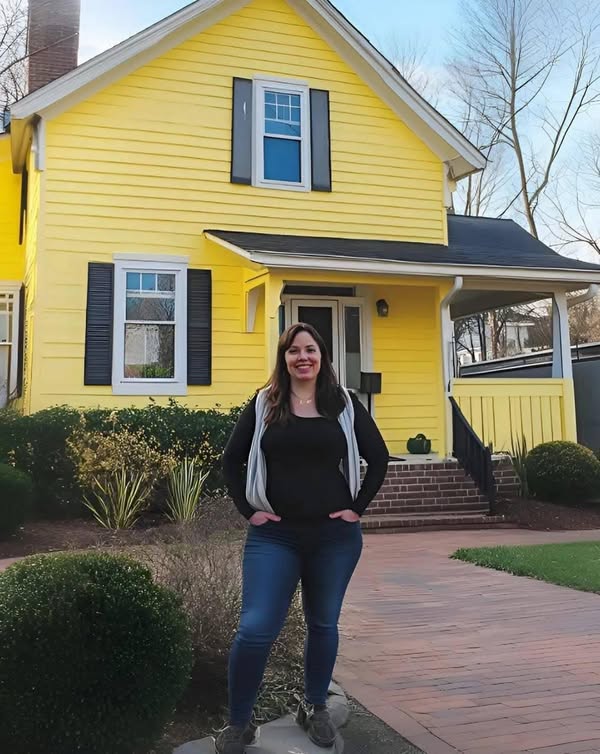
Victoria Hale had never imagined her cheerful home would one day become the center of a neighborhood controversy. Nestled on Maplewood Lane, a quiet street flanked with trimmed hedges and routine lives, her home stood out—not because of its size or shape, but because of its bold, vibrant color: a warm, sunshine yellow that caught the eye and stirred emotion.
She and her late husband, Michael, had painted it themselves.
It was a weekend project, done in the early spring, with the first breath of daffodils in the air. Michael had always believed that color influenced emotion, and yellow, he said, was “the color of resilience.” Victoria had laughed at that, teasing him for sounding like a greeting card. But she hadn’t argued. She liked the way the sunlight seemed to cling to their walls even in the gloomiest rain.

The paint job hadn’t been perfect. There were brush strokes in odd directions, a few drip marks on the trim, and one windowsill that had been done in a slightly different shade by mistake. But it was theirs. Every mark on that house had a memory behind it. Every corner told a story. It was a tribute to the love they’d built and shared for over two decades.
When Michael passed away suddenly just before their twenty-third anniversary, the house became her sanctuary.
She’d often sit on the porch in the evenings, a book in her lap, but rarely turning pages. The yellow paint seemed to hum with echoes of laughter and whispered dreams. It was comforting. It was healing. And though the neighborhood grew quieter around her, she never felt truly alone there.
That changed when the Davises moved in.
They were polite enough—at first. Nancy and Paul Davis introduced themselves with the usual small talk and a tin of store-bought cookies. But it didn’t take long before the criticisms started.
“This color’s quite… bold,” Nancy remarked one afternoon, frowning at Victoria’s home as they watered their potted plants.

“Yes,” Victoria replied, with a smile. “It reminds me of someone I loved.”
Nancy pursed her lips and didn’t reply.
Over the following months, the comments became more frequent. They’d mention property values, aesthetic cohesion, neighborhood harmony. Victoria would nod and then continue about her day. She knew what they really wanted: for her to repaint. To fall in line. To let go of the brightness that so offended their muted sensibilities.
But she refused.
It was her house. Her color. Her story.
Then came the work trip.
Victoria was a freelance botanical illustrator. Occasionally, she traveled to conventions or client installations. This time, she was contracted for a two-week project cataloging the restoration of a historic garden estate in another state. It was a dream assignment—she packed quickly, boarded her flight, and left her sun-kissed home behind.
She had no idea what she’d return to.
The first thing she noticed when her taxi turned onto Maplewood Lane wasn’t the silence or the stillness. It was the absence of brightness.
Something was wrong.
She leaned forward in her seat, squinting at her house.
Then her breath caught in her throat.
It was gray. A pale, dusty gray that looked like wet cement drying under clouded skies. The cheerful yellow had been covered entirely. The shutters were now charcoal. The front door—a bland off-white. It looked… lifeless.
The taxi driver glanced at her. “This your place?”
She nodded slowly, unable to speak.
After paying and retrieving her bag, she stood at the curb for several minutes. Her heart was pounding. Her hands shook. She thought, for a moment, she might be sick.
She opened the gate and walked to the front steps like someone visiting a grave.
The paint was fresh. Still slightly tacky. The scent of latex clung to the air.
Inside, nothing was touched. No signs of forced entry. Just the outside — repainted, stripped of its warmth.
She sat down on the porch, stunned.
Eventually, she stood and went door to door. No one answered. Curtains shifted behind glass. Porch lights turned off. Even the neighborhood dogs were silent.
It wasn’t until she knocked on Mr. Thompson’s door that someone finally acknowledged her.
The old man blinked at her from behind his glasses.
“I’m so sorry,” he said before she even spoke. “I didn’t know what to do.”
She listened in disbelief as he explained. How painters had arrived with gear and ladders. How Nancy Davis had directed them like a foreman. How she had shown the police—who were called by a concerned passerby—a set of documents claiming the repaint was “requested” by the homeowner.
“But they weren’t your documents,” Mr. Thompson added quietly. “I saw your name wasn’t anywhere. They just… lied.”
Victoria felt rage boil inside her chest.
She wasn’t just angry because her house had been painted. She was furious because of what it meant. It wasn’t about color. It was about erasure. About someone believing they had the right to rewrite her life, her grief, her memory—without her consent.
She visited the painting company next.
The manager was a young man named Joel. His hands trembled as she explained.
“They told us it was their house,” he muttered. “I didn’t double-check ownership. I just… we had work orders. We were behind schedule.”
“You destroyed something sacred,” Victoria said quietly.
Joel couldn’t meet her eyes.
She could have sued.
Her friends encouraged her to. Even Mr. Thompson offered to testify. But Victoria, after a long walk through the neighborhood park that evening, decided she wanted something different.
She wanted them to see what they’d done. And she wanted the world to know, too.
The next morning, a crew of graffiti artists arrived. She’d found them online—local talent known for murals, public installations, and bold color statements. They were thrilled to help.
Over the next three days, Maplewood Lane became an art gallery.
Spray paint cans hissed like whispers of rebellion. Ladders stood against walls like proud sentinels. Brushes danced across the siding. Victoria was there every day, in overalls, paint in her hair, directing, suggesting, laughing.
The gray melted away.
In its place rose a brilliant masterpiece: swirls of yellow sunlight, bursting from the corners. Golden sunflowers with petals that kissed the windows. Hummingbirds in flight. And written across the roof, in large, flowing script:
“Light beats dullness. With love, V.”
The mural stunned the block.
Cars slowed to stare. Kids pointed. Even local news crews came to interview her. Her story went viral. Bloggers praised her for “artful revenge.” Talk shows requested her presence.
She didn’t name the neighbors. But people guessed.
The Davises kept their blinds shut. They stopped gardening. They declined invitations. It was clear they hadn’t expected her to fight back—let alone with paint and poetry.
But Victoria hadn’t just reclaimed her home.
She inspired others.
Soon, other houses on the block began experimenting with color. A lavender porch. A mint green fence. A robin’s egg blue garage door.
The message was clear: individuality mattered. And memories shouldn’t be painted over to match someone else’s taste.
Victoria found herself smiling more.
Sometimes, when she stood on her porch, neighbors waved again. Conversations resumed. Life, like her home, bloomed in color.
One day, she received a letter.
It was from a teenage girl two towns over. Her father had passed away recently. She wrote that Victoria’s story gave her the courage to keep something he’d left behind—a rusted old truck painted bright orange. She wasn’t going to repaint it anymore. It was his. And now, hers.
Victoria read that letter three times.
She framed it and hung it in her hallway.
She knew Michael would’ve been proud.
The yellow house—the one that once seemed out of place—was now a beacon. A symbol. A declaration.
And every time the sun set behind it, the walls seemed to glow even brighter, as if saying: “We’re still here.”