
When you hear the phrase “The Mushroom House,” your mind might wander in several whimsical directions. You might envision a quaint woodland café nestled under a canopy of trees, steam rising from ceramic mugs, the scent of fresh herbs in the air. Perhaps it evokes images of a fantastical children’s playhouse—mushroom-shaped, complete with round windows and curved red roofs dotted with white. Or maybe it conjures a gentle nostalgia: the kind of serene place a fairytale character would call home. With a name that’s as playful as it is mysterious, “The Mushroom House” invites curiosity before even a single brick—or rather, a clump of earth—is laid.
But beyond the whimsical branding lies a story that’s far more real, raw, and revelatory than fiction. It’s a story that begins with a young woman, barely out of her twenties, standing at the threshold of a radical lifestyle shift. She wasn’t drawn to fame, fortune, or digital acclaim. Her dream was simpler but perhaps more courageous: to build a self-sustaining life entirely off the grid. And she chose to do so not with an above-ground cabin or solar-powered trailer—but with a house buried in the earth, a hidden underground sanctuary that quietly breathes with the land itself.
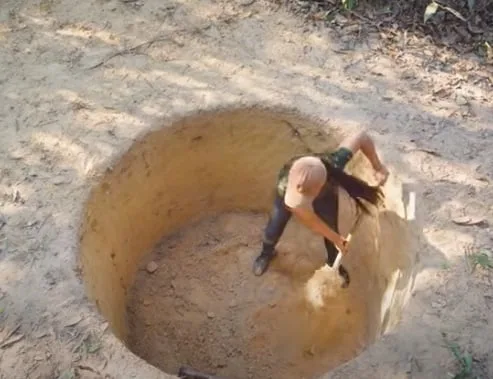
Welcome to The Mushroom House—not a business, not a gimmick, but a home, a philosophy, and a defiant reimagining of what it means to live well.
A Vision Rooted in Simplicity
The idea first took root during her university years, as she sat hunched over textbooks on ecology, architecture, and environmental ethics. As wildfires grew more frequent and housing prices more prohibitive, a question began to nag at her: What would it mean to live not just with less, but with purpose? What if, instead of spending decades climbing the corporate ladder only to afford a conventional home, she could build her own—immediately, affordably, and sustainably?
She wasn’t alone in asking these questions. Around the world, a growing number of people are questioning the viability of the status quo. From van-lifers to homesteaders to off-grid cabin dwellers, there’s a movement swelling quietly under society’s surface. But few take that ethos quite as literally as she did—by digging beneath the surface itself.
Building Beneath the Earth
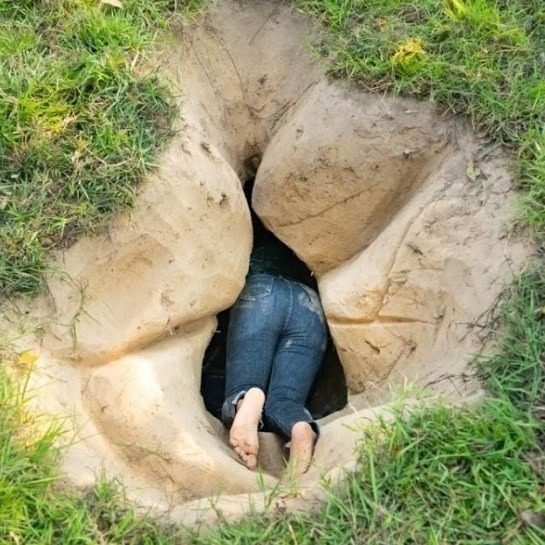
The plot of land she purchased wasn’t large. Tucked into a rural corner of the Pacific Northwest, it was surrounded by forest, soil rich with moss and fern. From above, there was little to see—just a gentle mound, almost imperceptible, like the forest had taken a deep breath and never quite exhaled. Only a narrow wooden door, embedded into the side of a hill and framed with stone, betrayed the presence of something manmade.
That door opened into her underground sanctuary—a dwelling she designed and built almost entirely by hand. There were no contractors. No blueprint drafted by an architect. Every measurement, every beam, every earthen wall was the result of months of research and years of hands-on learning.
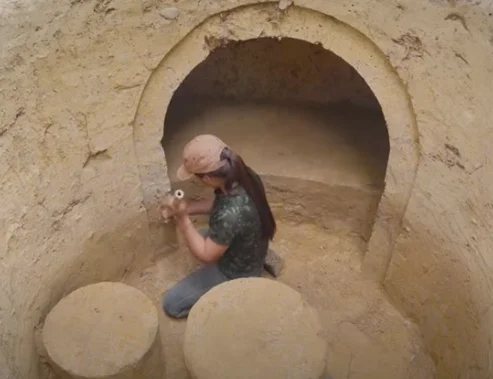
The interior? Astonishing.
Soft ambient lighting lines the arched earthen ceilings, powered by a combination of solar panels above and a compact battery system inside. The walls are sculpted with natural clay and straw, giving them a gentle, rounded texture reminiscent of hobbit lore—but with a minimalist, modern touch. The floor is poured earth, smoothed and sealed to create a surprisingly warm, tactile experience beneath bare feet.
There’s a small wood-burning stove in the center of the room, which radiates heat through strategically placed copper piping hidden beneath the floor—a homemade version of radiant heating. In the kitchen, shelves are lined with preserved jars from her summer harvests. Pickled beets, wild blackberries, fermented carrots. Every inch of the space is functional, yet beautiful in its simplicity.
Off-Grid, But Not Out of Touch
One of the most common misconceptions about off-grid living is that it must be synonymous with isolation or hardship. But The Mushroom House is neither.
While it lacks a connection to public utilities, it is rich with self-sustaining systems. Rainwater is captured and filtered through a gravity-fed system. Waste is composted using a dry toilet setup, and greywater is rerouted into a root filtration system that nourishes the surrounding land. For power, she relies primarily on solar energy, though she keeps a small wind turbine as backup during darker seasons.
Internet, surprisingly, is available via a low-orbit satellite connection, allowing her to remain digitally connected without depending on local infrastructure. This hybrid approach lets her freelance remotely, producing content about sustainable living, consulting on eco-builds, and occasionally sharing snippets of her underground life with the online community.
The Emotional Terrain
While the physical challenges of building and living underground were immense, the emotional landscape proved just as complex. Early on, she faced skepticism—not just from strangers online, but from loved ones who feared the idea was too extreme, too lonely, too…strange.
“People thought I was running away from the world,” she admits. “But I wasn’t running—I was choosing.”
That choice required more than logistics. It required her to redefine comfort, community, and even success. Where others might measure prosperity by square footage or property value, she began measuring it in days lived mindfully, meals cooked from her garden, mornings woken to birdsong rather than traffic.
A Community Emerges
As her story gained quiet traction online, others began to reach out. Young people disillusioned by the housing market. Middle-aged workers seeking simpler lives. Retirees looking to downsize with dignity. And slowly, The Mushroom House became more than a personal project. It became a touchstone—a symbol of what’s possible when courage meets creativity.
Some began to visit, attending small workshops on cob building, permaculture gardening, or passive heating. Others just followed online, inspired by her dedication to living a life deeply in tune with the planet. Through these connections, a loose but vibrant network of eco-dwellers began to form—people scattered across regions but connected by shared values and mutual encouragement.
Living with the Land, Not on It
Perhaps the most profound aspect of The Mushroom House is its integration into the landscape. From above, you’d be hard-pressed to even locate it. The roof is covered in native mosses and plants, which act as natural insulation and camouflage. Wildlife passes overhead undisturbed. Birds nest in nearby trees. The land isn’t interrupted by the house—it embraces it.
This ethos—of building with the land, not against it—is something she hopes will spread. In a world of rising sea levels, heatwaves, and resource scarcity, architecture must adapt. And sometimes, the most radical solutions are also the most ancient.
“There’s nothing new about earth homes,” she says with a smile. “We’ve just forgotten how wise our ancestors were.”
Looking Ahead
For now, The Mushroom House remains a personal sanctuary. It is not open to the public, nor is it for sale. It’s not a brand or a development. It is, first and foremost, a home.
But its story—told through quiet blog posts, occasional videos, and the testimonials of those she’s mentored—is beginning to seed new dreams across the world. Young people are sketching out their own underground blueprints. Retirees are scouring forest land for their own off-grid retreats. Parents are teaching their children to build not just with tools, but with respect for nature.
And in a cultural moment where housing is often equated with crisis and competition, The Mushroom House offers something rare: a vision of possibility, rooted in peace, and grown beneath our very feet.